How to Use Your Website To Attract Clients Who Are Ready to Buy (Before You Even Get on a Call)

If your website is technically “working” but your inquiries still feel… off, you’re not alone.
Common problems:
You’re getting messages from people who are “just exploring.”
You’re hopping on calls that go nowhere.
You’re explaining the same things over and over again.
And you’re left wondering: why isn’t my website doing more of the heavy lifting?
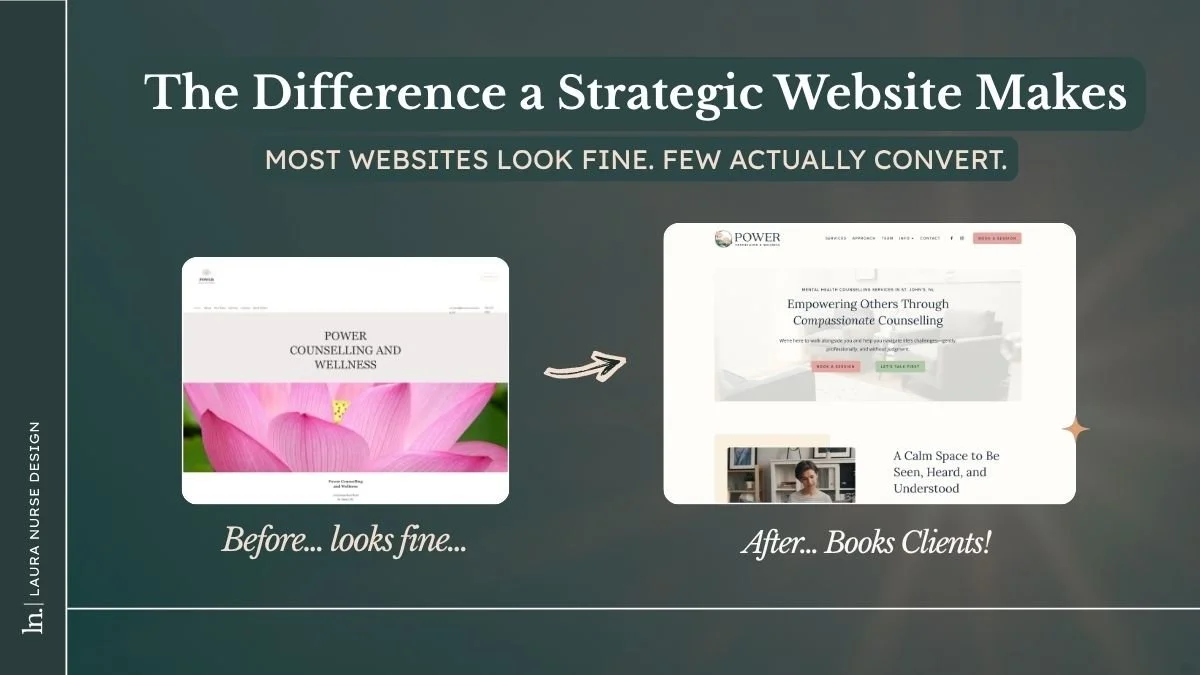
Because the truth is, most websites aren’t built to qualify or pre-sell. They’re built like brochures.
But when your website is set up properly, everything changes.
You start getting inquiries from people who already understand your pricing, your process, and whether you’re the right fit. You hear more “I’m ready to book! What’s next?” and a lot less “just exploring.” And your sales calls get shorter… or disappear entirely.
In this post, I’ll walk you through three practical ways to turn your website into something that actually supports your sales process, so you’re spending less time convincing and more time working with the right clients.
Let’s break it down.
Strategy 1: Structure Your Website So That It Guides the Right Clients to Say Yes
People don’t “read” websites… They scan them.
So if your site isn’t clear quickly, the right people leave. Not because they’re not interested, but because they can’t tell if it’s for them.
This is where most websites fall short.
They have the right pages:
Homepage
Services
About
Contact
…but they content on them is not structured to actually help someone decide.
(And that’s the job, btw)
A good website doesn’t just share information. It reduces uncertainty and moves people along the buyers journey.
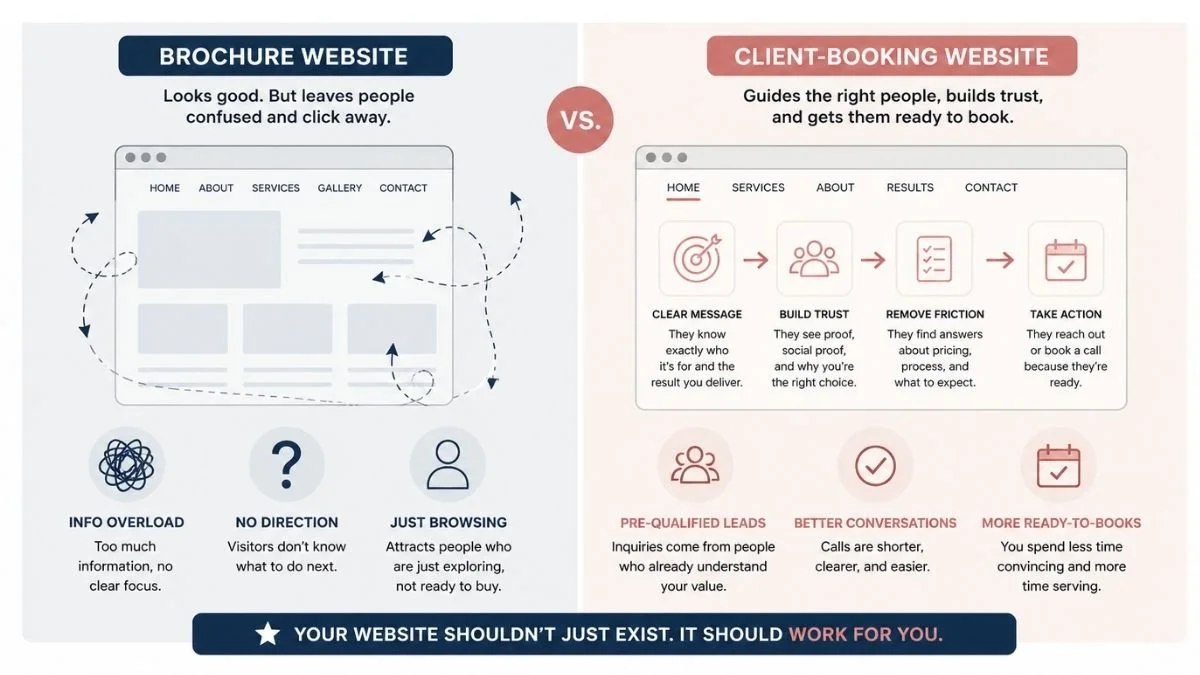
Sometimes that’s as simple as changing the flow.
Sometimes it’s adding something that helps people move faster.
For example, on a residential cleaning website, we added a quote calculator. 👇
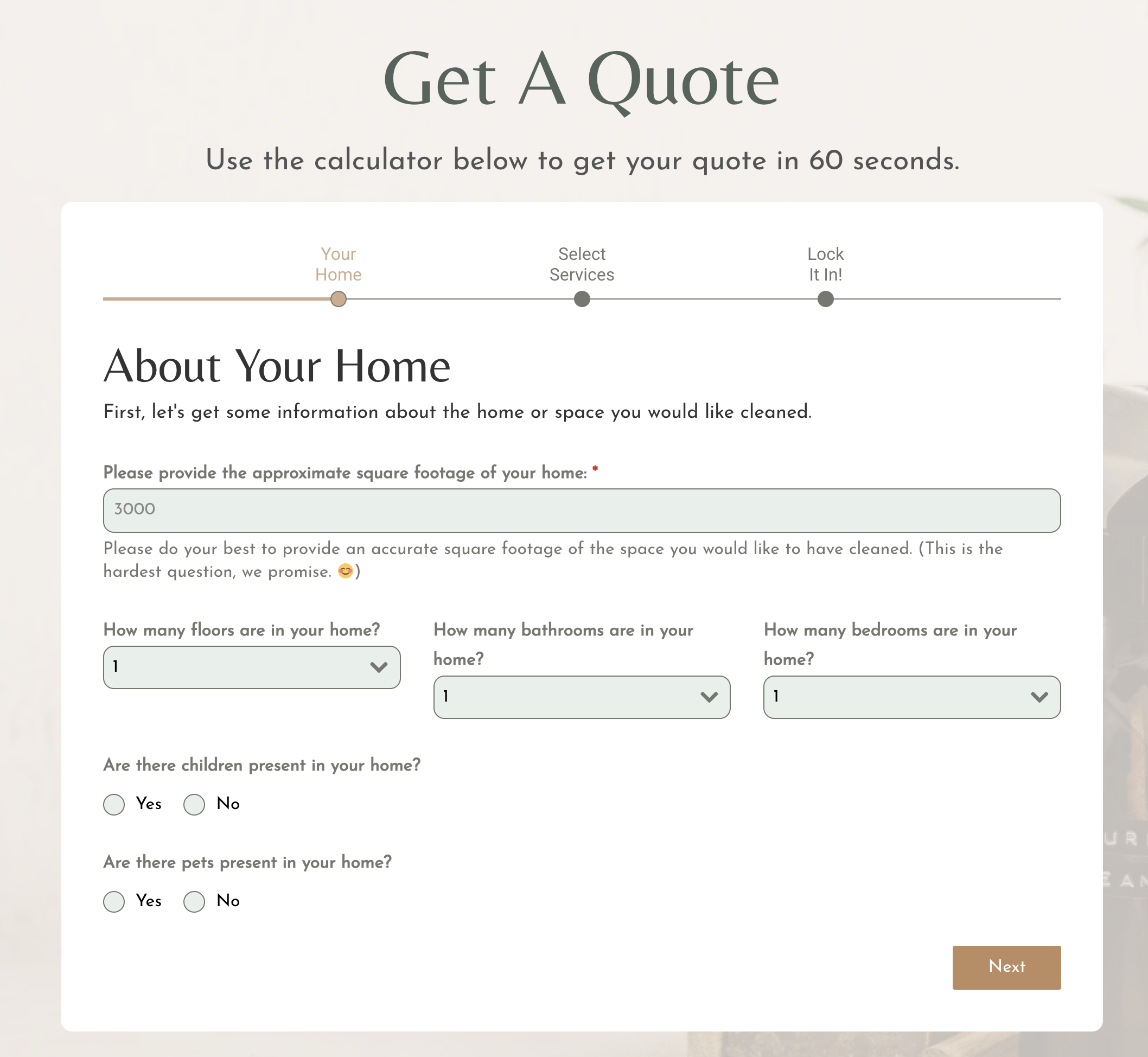
Screenshot of a Get A Quote calculator I built on a client’s site.
Instead of asking people to reach out for pricing, they can:
get a rough quote right away
see what the investment looks like
and then choose to lock it in by booking a call
What happened?
Fewer “just checking prices” inquiries.
More people coming in already comfortable with the numbers.
Better conversations from the start.
That’s the kind of shift that saves time for everybody.
Other practical ways this shows up:
Adding light qualification on your contact page, such as "common reasons to get in touch"
Replacing vague “get in touch” language with a clear value from taking the next step
Structuring pages so people build trust before you ask them to act
And your homepage still does the heavy lifting.
Within a few seconds, it should be obvious:
who this is for
what you do
what result you help create
From there, the rest of the site answers:
Do I trust you?
Are you the right fit for me?
Inside my "Good-Looking, Client-Booking Website" process, I map this out using sales frameworks and what I know works across similar service businesses. Each page has a job. Each section has a reason to exist.
And while I’m not writing your copy, I am helping you get clear on what needs to be said and where, so the site actually does something.
Strategy 2: Use Your Messaging to Attract (and Filter) the Right Clients
You don’t need to explain everything about your company on your website.
You need the right information in the right places to help people make a decision about whether to work with you.
Most people either under-explain or over-explain.
Neither works.

Right-fit clients are scanning for a few key things:
Is this for me? Does it solve my problem?
Do I trust this person? Can they get the job done?
Is this worth it? Is the value for dollar/ROI acceptable to me?
Your messaging should help them answer that quickly.
This isn’t about becoming a persuasive genius of a copywriter. (Although, if you are it can only help!)
It’s about having enough structure that your message becomes clear by default.
When I plan websites with clients, we’re not trying to write perfect copy.
We’re figuring out:
what each page needs to communicate
what points actually matter for a decision
what someone needs to see to feel confident moving forward
That alone cleans up most messaging issues.
A few practical shifts:
Speak to a specific type of client (you don’t need everyone)
Focus on outcomes, not just what’s included
Add "who it's not for" filters (1-2 is enough)
Be upfront about pricing range and process
This doesn’t push people away, it helps the right people move faster.
And it quietly filters out the ones who were never going to be a good fit anyway.
Strategy 3: Test, Tweak, and Improve Based on Real Data
This is the unglamorous part, and it’s what actually makes your website #werk.
The truth is, you can’t guess your way to a high-converting website. (Believe me, I’ve tried. 😅)
You start with best practices.
You build something solid.
And then you pay attention to what people actually do, and improve on it.
That might mean:
noticing where people drop off
seeing which pages lead to inquiries
testing small changes and watching what happens
You don’t need constant redesigns.
You need small, controlled improvements.
Change a headline.
Adjust a CTA.
Reorder a section.
Let it run. See what happens. Decide from there.
And if you’re not tracking anything yet, that’s fine. Time to start.
The important shift is this:
Your website isn’t a one-time project.
It’s something you refine over time.
I Know What You're Thinking...
But Laura... I don’t have time to fix my website right now.
You don’t need to redo everything. A few strategic changes will usually go further than a full rebuild.
But Laura... My business isn’t ready yet.
Your website is part of how you get ready. It forces clarity and starts attracting better-fit leads at the same time.
But Laura... I already have a website.
That’s fine—but is it doing anything? Most sites exist, but they’re not helping people decide or take action.
But Laura... I need more traffic, not a better site.
More traffic to a weak site just gives you more of the same results. You can try to make up for a conversion gap with volume, but that gets old fast. Fix the conversion piece so your website does more of the work for you, and you stop feeling like you’re constantly pushing or convincing people.
Bringing It All Together
If your goal is to attract clients who are ready to move forward, your website needs to do more than exist.
It needs to:
guide decisions with clear structure
communicate the right information (not all the information)
improve over time based on real behaviour
You don’t need more platforms.
You don’t need more content.
And you certainly don’t need to “be everywhere”.
You need a website that actually does its job.
When that’s in place, things get easier.
Better inquiries.
More clarity.
More confidence sending people to your site.
Ready for Your Website to Start Pulling Its Weight?
If your website isn’t bringing in right-fit, ready-to-book clients, it’s not doing what it’s supposed to do.
AND…. that’s a totally fixable problem!
If you want a website that’s clear, structured, and built to support real sales conversations, you can book a consultation or inquire about a project.
We’ll look at what’s working, what’s not, and what would actually make a difference.
No fluff. Just a plan.